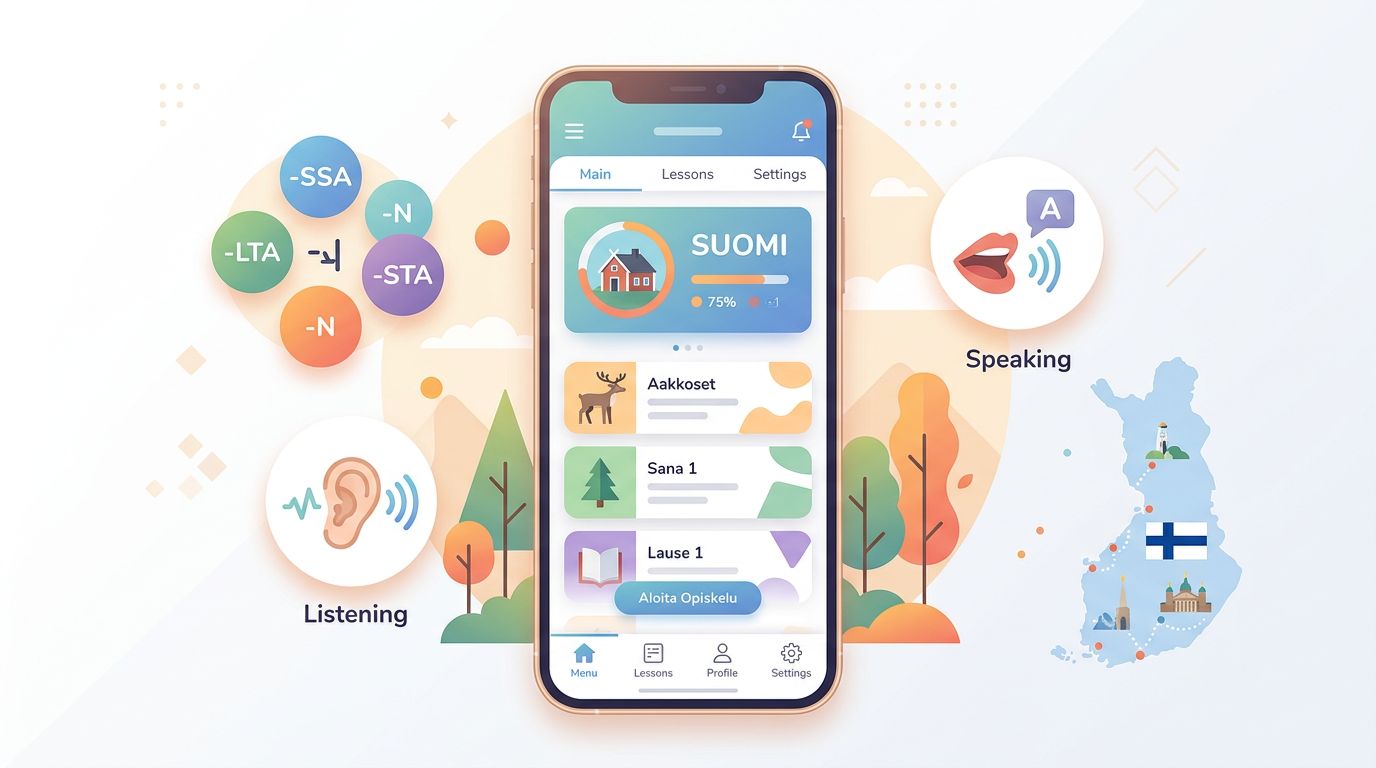
Finnish punishes lazy app choices. If you only want streaks and quick wins, almost any app can keep you busy. If you want measurable progress, the bar is much higher.
You need grammar support, strong review, real listening, and a path to speaking. Finnish cases, long words, and word order changes make that mix non-negotiable. The best Finnish learning apps in 2026 are the ones that help you build habits without trapping you in beginner fluff.
What serious Finnish study actually needs
A useful app for Finnish has to do more than show you isolated words. It should teach you how words change in context, because Finnish does that constantly. A case ending can change the whole shape of a sentence, and a neat flashcard deck won’t fix that on its own.
That is why serious learners should look for structured progression, spaced review, and real sentences. Pronunciation matters too, because Finnish spelling looks friendly until your mouth has to say the word out loud. Listening and speaking also need space early on, not as an afterthought.
If an app only teaches recognition, it leaves the hardest part to you.
For a broader sense of what structured lesson flow should feel like, the Babbel review is a useful reference point, even if Babbel itself does not teach Finnish.
The strongest Finnish learning apps in 2026
The best setup is usually a stack, not a single app. The table below shows where each option fits best.
| App | Best for | Strengths | Limits | Platform / price |
|---|---|---|---|---|
| Duolingo | First contact and habit building | Easy daily practice, basic vocab, short drills | Light grammar, weak speaking depth | Web, iOS, Android, freemium |
| Speakly | Practical everyday Finnish | High-frequency words, useful sentences, clearer structure | Smaller ecosystem than larger apps | Web, iOS, Android, subscription |
| WordDive | Finnish-specific foundation | Strong review, practical vocabulary, focused study | Less flexible than open content tools | Web, iOS, Android, subscription, trial |
| Clozemaster | Vocabulary in context | Sentence-based repetition, strong retention | No full grammar teaching, no real speaking | Web, iOS, Android, freemium |
| Pimsleur | Pronunciation and listening | Audio-first speaking practice, good recall | Pricey, weak for reading and writing | Web, iOS, Android, subscription |
| LingQ | Reading and immersion | Authentic text, word tracking, lots of input | Grammar needs outside support | Web, iOS, Android, freemium, subscription |
| italki | Speaking with real people | Tutor feedback, custom lessons, real conversation | No built-in curriculum, costs vary | Web, iOS, Android, pay per lesson |
| Quizlet | Custom review decks | Flexible recall practice, easy to build your own sets | You must create the material | Web, iOS, Android, freemium |
The pattern is clear. Duolingo and Pimsleur help you start. Speakly, WordDive, and Clozemaster carry more of the real study load. LingQ and italki become more valuable once you want serious input and output.
How the main apps behave in real study
Duolingo, useful at the start, limited after that
Duolingo still works well for absolute beginners who need a routine. It makes Finnish feel less intimidating, and that matters in month one. The app is also polished enough to keep people coming back.
Its weakness shows up fast. Grammar explanations stay thin, speaking practice is limited, and the exercises can feel repetitive once you want real progress. For a deeper look at that trade-off, the Duolingo review for language learners covers where it helps and where it stops helping.
Use Duolingo as a warm-up, not as your main course. If you treat it like a full study plan, your progress will stall.
Speakly and WordDive, better for serious beginners
Speakly is stronger than most gamified apps because it pushes useful Finnish first. It focuses on high-frequency vocabulary and practical sentences, so you spend time on what shows up in real life. That makes it a better fit for expats and self-studiers who want daily-use Finnish, not random trivia.
WordDive feels even more Finnish-focused. It has a strong review loop and a clear practical bent, which is why it keeps showing up in Finnish learner discussions. Edunation also lists WordDive as a useful Finnish app, and that matches its real strength, steady review of words that matter.
Neither app replaces speaking practice. Still, both are far more serious than a pure streak app. If your goal is durable vocabulary, these two deserve attention.
Clozemaster, LingQ, and Quizlet, where context starts to matter
Clozemaster is one of the best tools for pushing Finnish into context. Instead of isolated words, you see them inside sentences, which helps you feel how forms change. That is especially useful once you already know basic vocabulary and want it to stick. Their Finnish app guide reflects that same sentence-first method.
LingQ fills a different gap. It gives you real Finnish input, tracks words you know, and lets you read with support instead of guessing blind. That makes it strong for learners who want to spend more time with actual Finnish text and audio. The downside is simple, you still need outside grammar help.
Quizlet is less elegant, but it can be useful if you build your own decks. It works well for case endings, example sentences, and words you keep forgetting. Serious learners often use it as a personal review tool, not a standalone course.
Pimsleur and italki, the speaking pair
Pimsleur is still one of the best ways to build early pronunciation confidence. The audio-first format forces you to answer aloud, which is exactly what many app learners avoid. It also helps with listening rhythm, a real benefit in a language that sounds different on the page than in the ear.
Its cost is the main problem. Pimsleur is usually more expensive than flashcard-style apps, and it does not go far with reading or writing. Even so, it can save beginners from silent-study habits that are hard to break later.
italki is the most direct path to real speaking. You get feedback from a human, not a script. That makes it essential for lower-intermediate and advanced learners who need correction, speed, and real conversation. The catch is that it has no built-in curriculum, so you need to bring a plan.
Where gamified apps help, and where they stop
Gamified apps are useful when they build momentum. They are less useful when they pretend that momentum is mastery. Finnish needs more than taps and streaks because the language rewards accurate forms, not just recognition.
That means beginner-friendly apps work best when they are part of a larger routine. A short daily session can keep Finnish in your head, but your real progress comes from sentence work, listening, and spoken output. The app should support the habit, then get out of the way.
For most serious learners, the question is not whether a gamified app is fun. The question is whether it helps you move toward real texts and real conversations. If it doesn’t, it stays in the support role.
The best Finnish app stacks by level
For beginners, the cleanest stack is Duolingo + Pimsleur + WordDive. Duolingo builds the habit, Pimsleur gets your mouth working, and WordDive anchors the vocabulary in a more Finnish-specific way. If you prefer more structure from day one, swap Duolingo for Speakly.
For lower-intermediate learners, Speakly + Clozemaster + italki is a strong mix. Speakly keeps the core vocabulary practical, Clozemaster builds sentence-level recall, and italki forces real output. Add LingQ if you want more reading and listening input.
For independent advanced learners, LingQ + italki + Clozemaster + Quizlet works well. LingQ gives you volume, italki keeps your speaking honest, Clozemaster supports fast review, and Quizlet can hold the words or sentence patterns you keep missing. That stack is less flashy, but it is more realistic.
If you want one sentence to guide the whole process, use this one: choose one app for habit, one for review, and one for speaking or input.
Conclusion
Finnish rewards learners who stay organized. That is why the best app is rarely the one with the prettiest streak screen. It is the one that keeps grammar, vocabulary, listening, and speaking in the same study plan.
For 2026, the smartest choices are clear. Use Duolingo or Speakly to start, WordDive or Clozemaster to build recall, Pimsleur or italki to make speech real, and LingQ when you are ready for more input.
The strongest Finnish progress comes from a stack that fits your level, not from chasing one perfect app.
Ready to Take Your Language Learning Further?
Your favorite language-learning app is a great place to start. Rocket Languages can help you go further with interactive audio lessons, pronunciation practice, real-world conversations, and structured learning.
Explore Rocket Languages →Affiliate disclosure: We may earn a commission if you purchase through this link, at no additional cost to you.