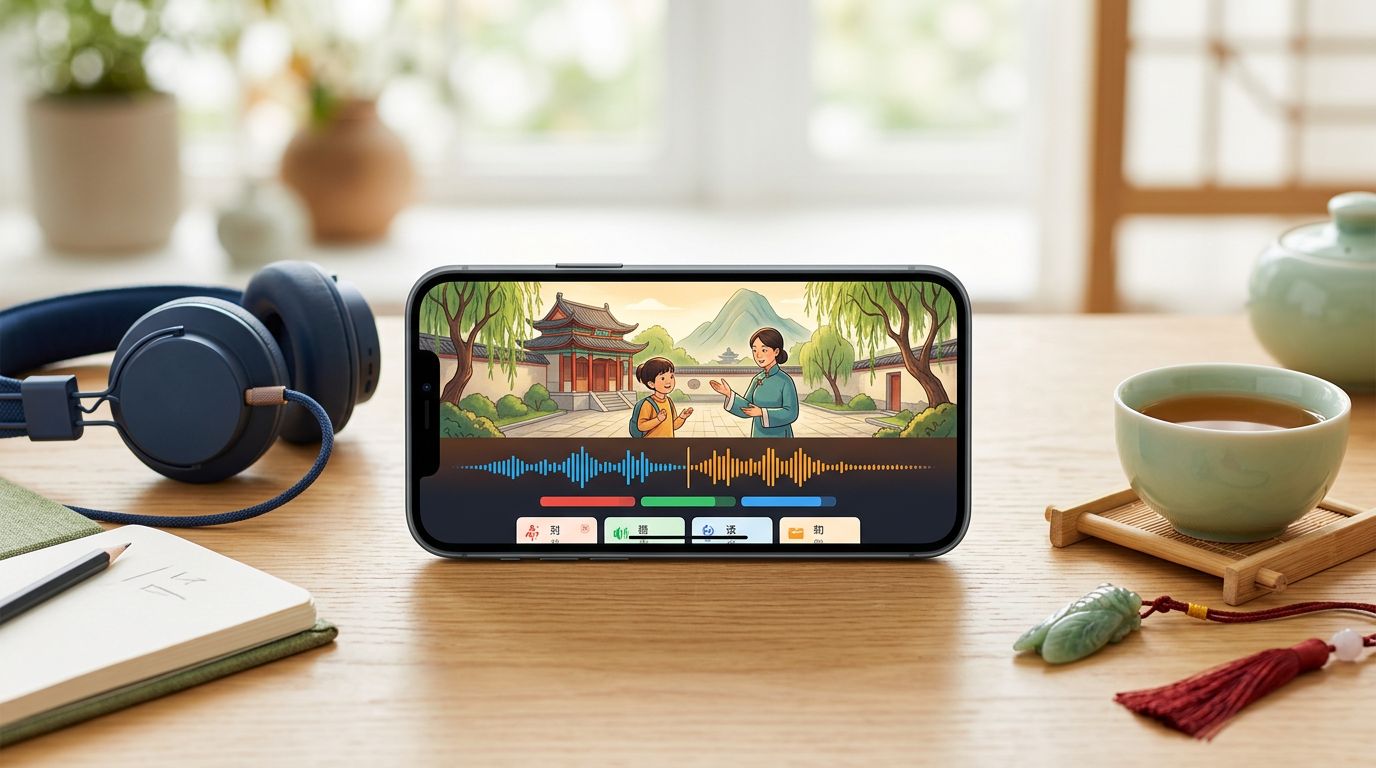
Many Mandarin learners reach a point where textbook dialogues feel too easy, while native content still feels exhausting. Dong Chinese targets that gap with level-adjusted stories, interactive subtitles, vocabulary tools, and media made for learning through context.
As of July 2026, the app is active on iOS and Android. It is most useful for intermediate and advanced students who want more reading and listening practice. It isn’t a complete Mandarin course, and beginners may find its lack of structured grammar instruction limiting.
Key Takeaways
- Dong Chinese is strongest for contextual reading, vocabulary growth, and learner-friendly exposure to real Mandarin.
- AI-generated stories, YouTube subtitles, media collections, and sentence review make it flexible for self-directed study.
- The app doesn’t replace a structured course, a full dictionary, grammar reference, conversation practice, or detailed pronunciation feedback.
- Intermediate learners will get the clearest value, while advanced students can use it to increase reading volume.
- Its value depends on the current subscription terms shown in your region, so check the Apple App Store or Google Play listing before paying.
What Dong Chinese Offers Mandarin Learners
Dong Chinese, also written as DongChinese, is a Mandarin learning app built around context rather than isolated vocabulary lists. Its developer, Peter Olson, created it after studying at GoEast Mandarin. The central idea is simple: learners remember words more effectively when they meet them inside meaningful sentences.
That approach separates Dong Chinese from apps that follow a fixed beginner course. You don’t move through the same lessons as every other user. Instead, you select or receive content that matches your vocabulary and reading ability.
The app includes AI-generated stories on subjects such as travel, food, technology, daily routines, and Chinese culture. It also provides a growing collection of sentences, images, songs, videos, and podcasts. You can tap unfamiliar words while reading, see pinyin and English definitions, and review sentences later.
As of July 2026, Dong Chinese remains available through both major mobile platforms. Availability, subscription options, trial periods, and prices can vary by country, device, and store account. The current purchase screen in your region is more reliable than an old review or cached price.
The name can create some confusion. Dong Chinese is a Mandarin learning product, not a course in the Dong, or Kam, language spoken by the Dong people in parts of southern China.
The app makes the most sense after you’ve learned basic pronunciation, common sentence patterns, and beginner vocabulary. If you already understand simple Mandarin but need more exposure, it can turn spare minutes into useful input.
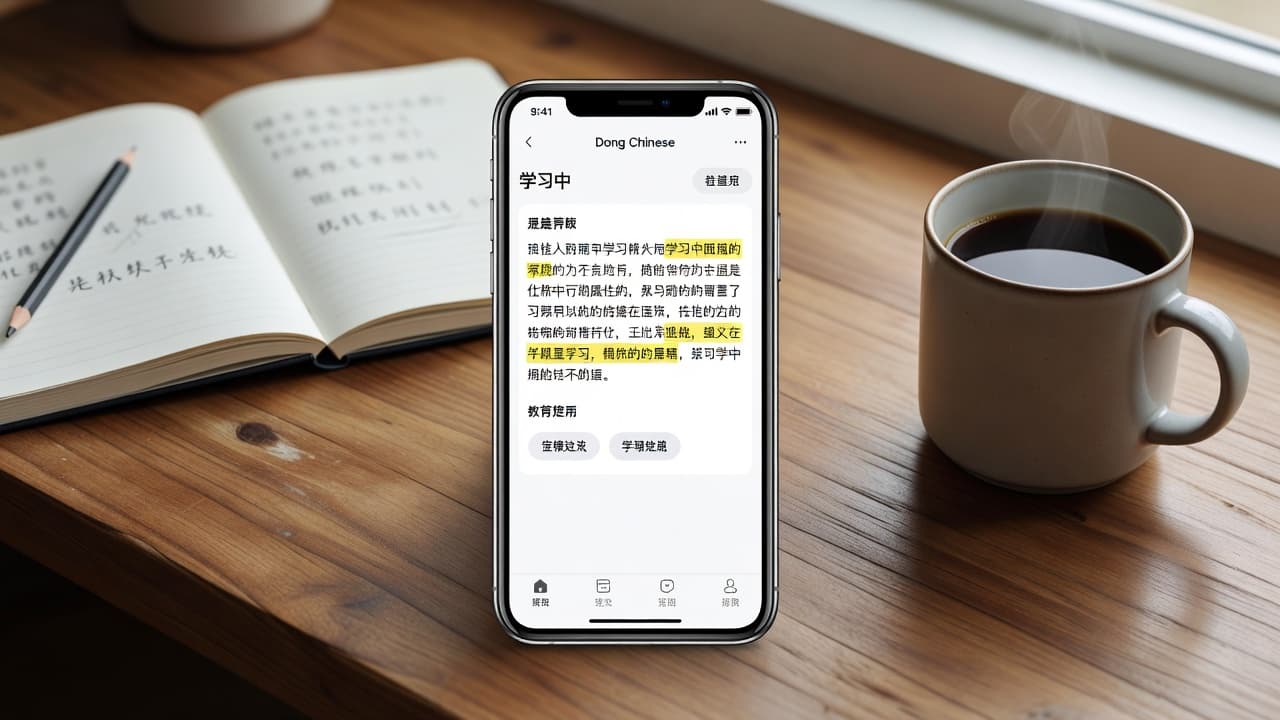
Dong Chinese places highlighted vocabulary inside short reading passages instead of presenting every word in isolation.
The Features That Matter Most
Dong Chinese has a wide feature set, but some tools are more valuable for serious learners than others. The strongest parts are connected to reading, sentence exposure, and vocabulary review.
AI-generated stories
You can generate short Mandarin stories around a chosen topic and adjust the content to your level. The stories are intended to use vocabulary you know while adding manageable new words.
This helps solve a common problem with native material. A Chinese news article, vlog, or novel may contain too many unknown words to read comfortably. A shorter level-adjusted story gives you more control over the difficulty.
AI generation also makes the content flexible. A learner preparing for travel can request situations involving hotels, restaurants, trains, or directions. Someone interested in Chinese history or cooking can choose related subjects instead.
However, generated content needs judgment. AI can produce awkward wording, repetitive plots, or sentences that are grammatically possible but less natural than something a native speaker would say. Treat stories as guided practice, not unquestionable authority.
Tap-to-lookup reading
Unknown words are highlighted or available through in-app lookup. Definitions, pinyin, and pronunciation information appear without forcing you to leave the passage.
That small detail changes the reading experience. Looking up a word in a separate dictionary often breaks concentration. Dong Chinese keeps the meaning close to the sentence, so you can read, check, and continue.
The dictionary data includes CC-CEDICT, a widely used Chinese-English dictionary project with more than 120,000 entries. Definitions are useful for basic comprehension, but serious learners should still check example sentences and usage before adding a word to long-term vocabulary review.
YouTube subtitles and media
Dong Chinese can add interactive Hanzi subtitles to YouTube videos. Depending on the video and available caption data, you can access translations, pronunciation support, and character information while listening.
This feature is more useful than a simple transcript because it connects listening with reading. You can replay a line, inspect a new word, and return to the same sentence without switching between several tools.
The media library also includes songs, podcasts, captioned images, videos, and example sentences. The quality and difficulty of individual items may vary, so you’ll need to choose material carefully. A large collection only helps when you can find content that matches your interests and level.
Character and handwriting tools
Dong Chinese includes explanations of character components and etymology, along with handwriting practice. These features can help learners who recognize characters but struggle to remember how they are formed.
Component information is especially useful when several characters look similar. It can give you a memory hook and help you notice recurring parts. Still, etymology shouldn’t be treated as a complete explanation of modern meaning or pronunciation. Character history is often more complicated than a simple visual story.
Handwriting practice is optional for most learners. It matters more if you plan to write by hand, study calligraphy, take handwritten exams, or build stronger character recall.
Sentence-based spaced repetition
The review system focuses on words and sentences in context. This is a sensible choice for Mandarin because a word’s meaning and grammar often depend on its surrounding sentence.
Dong Chinese also offers AnkiWeb integration, which can personalize content around vocabulary already stored in your Anki collection. That can reduce duplication for learners with an established flashcard system.
The app supports simplified and traditional characters, offers multiple reading display modes, and can save stories for offline rereading. These details won’t matter to every student, but they make regular practice easier.
Where Dong Chinese Helps Serious Learners
The best part of Dong Chinese is its ability to increase the amount of understandable Mandarin you encounter each week. Serious learners usually know they need more input, yet finding suitable content takes time.
A textbook may introduce a phrase once and move on. Dong Chinese can place related vocabulary in several short passages. Repeated exposure helps you recognize words faster and notice how they behave in sentences.
Reading is the clearest strength. You can start with a short story, tap only the words that block comprehension, and reread the passage without assistance. That process builds tolerance for unfamiliar vocabulary while keeping the material accessible.
Listening also benefits when you use the subtitle feature actively. Instead of watching a video with English subtitles, you can first listen without help, then read the Hanzi, inspect difficult phrases, and replay the line. This creates a practical bridge between slow learner audio and unscripted native speech.
Vocabulary learners will appreciate the connection between content and review. A new word such as 适应, meaning “to adapt” or “to adjust to,” becomes easier to remember when you see it in a sentence about adapting to life in a new city. The sentence provides grammar, collocation, and meaning at once.
For intermediate students, this contextual support can prevent a common plateau. You may know many individual words but still struggle to read a paragraph smoothly. Dong Chinese gives those words more chances to appear together.
Advanced learners can use it differently. At higher levels, the app is less about learning every new word and more about maintaining a steady reading habit. Short stories and selected media can fill quiet periods when a full novel or news article feels too demanding.
The app also suits learners who dislike rigid lesson paths. If your interests change often, you can move between topics without abandoning your study routine.
The Main Limitations in a Dong Chinese Review
Dong Chinese has a clear weakness: it doesn’t provide the complete instructional structure that many learners need. The app focuses on content and vocabulary rather than systematic grammar teaching.
A beginner may learn words such as 想, 要, and 会 without understanding how their meanings and sentence positions differ. The app can show these words in examples, but examples alone may not answer every grammar question. Beginners need a course that explains word order, aspect markers, measure words, and basic sentence patterns in a planned sequence.
Intermediate learners may also need outside references. When a sentence feels confusing, you’ll often have to consult a grammar guide, teacher, or dictionary. A resource such as the best Chinese grammar apps can fill that gap, especially when you need an explanation rather than another example.
AI-generated stories bring a second limitation. Difficulty settings can help, but they don’t guarantee natural language. A sentence may be understandable yet unusual. If you copy every generated sentence into Anki, you risk memorizing phrasing that sounds less natural in conversation.
Human-created media has different problems. Real videos and podcasts contain speech reductions, regional accents, slang, cultural references, and missing context. Dong Chinese can make them easier to process, but it can’t remove the need to listen carefully.
The pronunciation support is also limited compared with specialist speaking tools. Pinyin and tone information are useful for recognition, but they don’t provide a full assessment of your tones, rhythm, or connected speech. Learners who want focused pronunciation work should pair it with dedicated Mandarin tone training apps.
Another concern is the amount of choice. A flexible library can become a source of indecision. If you spend more time browsing topics than reading, the app stops helping. Serious learners need a simple routine and a clear limit on daily activities.
Finally, feature availability may change. AI generation, media access, offline storage, Anki integration, and subscription benefits can differ across operating systems or app versions. Check the current product listing and settings before building your entire study system around one tool.
Dong Chinese works best as a content and review layer. It should support your Mandarin system, not carry the entire system alone.
How to Use Dong Chinese in a Serious Study Routine
The app becomes more effective when you give each session a narrow purpose. Trying to use every feature at once creates busywork.
A practical 30-minute session might look like this:
- Read one short story or watch a short captioned clip without looking up every word.
- Review the five to ten words that blocked comprehension.
- Reread or replay the material, this time focusing on sentence meaning.
- Save useful sentences for later review.
- Say a few sentences aloud or write a short summary from memory.
During the first pass, avoid stopping for every unfamiliar item. Look up a word when it prevents you from understanding the sentence, appears several times, or seems useful for your goals. This keeps reading practice from becoming a dictionary exercise.
On the second pass, pay attention to word combinations. Mandarin vocabulary is often easier to use when you learn common chunks rather than single characters. For example, learning 提高效率 as one phrase gives you a more practical unit than memorizing 提高 and 效率 separately.
Use AI stories for controlled input, then move toward real material. A generated story about ordering food can prepare you for a restaurant video. A short podcast can then show how people express the same idea in less predictable language.
If you already use Anki, avoid sending every new word into your deck. Add sentences that contain useful grammar, a frequent collocation, or a meaning you repeatedly forget. A smaller review queue is easier to maintain.
Reading aloud can add speaking practice, but it isn’t a substitute for conversation. Record yourself, compare your rhythm with the audio when available, and discuss weak points with a tutor or language partner.
Keep grammar study separate when needed. If you encounter a difficult 把 sentence or a confusing use of 了, write down the example and consult a grammar reference. Then return to Dong Chinese and find more examples of the same structure.
For a broader tool combination, LanguaVibe’s comparison of essential Chinese learning apps offers useful alternatives for courses, dictionaries, flashcards, and conversation practice. Dong Chinese is more likely to shine when one of those jobs is already covered elsewhere.
Dong Chinese Compared With Other Mandarin Tools
Dong Chinese occupies a specific position in the Mandarin app market. It is closer to a graded reader, media assistant, and contextual vocabulary system than to a full course.
A structured app such as HelloChinese is more suitable for learners who need a guided path through beginner grammar, pronunciation, and core vocabulary. Its Google Play listing describes a course designed to take learners from the beginning toward conversation. That makes it a different type of product, not a direct replacement for Dong Chinese.
Pleco remains important for serious learners because it functions as a dictionary and reference tool. Its detailed entries, example sentences, flashcards, and add-ons can support study beyond what an in-app lookup provides. Many learners will use Pleco beside Dong Chinese rather than choose one.
Anki offers greater control over card design, scheduling, and personal data. Dong Chinese is easier when you want sentences and content without building everything yourself. Anki is stronger when you want to manage a carefully designed long-term review system.
Chinese Grammar Wiki and similar references answer questions that Dong Chinese doesn’t address systematically. A grammar explanation can clarify a pattern in minutes, while repeated exposure may take much longer.
A separate tutor or conversation partner remains necessary for spontaneous speaking. Dong Chinese can prepare vocabulary and listening material, but it can’t respond to your meaning, repair misunderstandings, or judge whether your phrasing fits a real conversation.
Independent comparisons such as DigMandarin’s Chinese app roundup can help you compare Dong Chinese with broader course and reference options. Since app features and prices change, treat older comparisons as background and verify current listings before subscribing.
Pricing, Availability, and Value in 2026
Dong Chinese is available on iOS and Android as of July 2026, but prices and purchase options may vary by store and region. Tax, currency conversion, introductory offers, subscription periods, and feature access can all affect the amount you see.
That uncertainty makes a simple value calculation more useful than a fixed price claim. Ask how often you’ll use the app and which tool it replaces. If you read or listen with Dong Chinese five days a week, its contextual content may justify a paid plan. If you open it once every two weeks, even a low price may be poor value.
A free trial or limited version, if offered in your region, should be tested with a specific routine. Read several stories, use the subtitle tool, examine vocabulary review, and check whether the content feels natural enough for your level. Don’t judge the app only by its feature list.
Budget-conscious learners can combine a free dictionary, public media, and a basic flashcard system. Community discussions about actually free Chinese learning apps show how learners build low-cost combinations, although recommendations and app availability can become outdated.
For serious learners, Dong Chinese is worth considering when it increases your weekly Mandarin input. Its value is lower if you already have a graded reader, a strong subtitle workflow, and a well-maintained sentence deck that you use consistently.
Who Should Use Dong Chinese?
Dong Chinese is a strong fit for:
- Intermediate learners who can read basic Mandarin but need more volume.
- Advanced learners who want short, manageable reading and listening sessions.
- Students building vocabulary through examples instead of isolated word lists.
- Self-directed learners who want topics matched to their interests.
- Learners of simplified or traditional characters who want flexible display options.
- Anki users who want content connected to an existing vocabulary collection.
It is less suitable for complete beginners, exam candidates who need a precise syllabus, and learners seeking detailed speaking correction. It also won’t satisfy students who want every grammar point explained inside one linear course.
The clearest recommendation is to use Dong Chinese after a foundation course. Pair it with a dictionary, grammar reference, and regular speaking practice. That combination gives the app a defined job and prevents its gaps from becoming study problems.
Final Verdict: Is Dong Chinese Worth It?
Dong Chinese is worth it for serious Mandarin learners who need more understandable reading and listening practice. Its contextual stories, interactive subtitles, sentence review, and flexible media library can make regular exposure easier to sustain.
The app isn’t a standalone path to fluency. Beginners still need structured instruction, while advanced students should verify AI-generated phrasing and continue using authentic content. Prices and features may vary by platform or region, so check the current offer before subscribing.
If your main problem is finding Mandarin content at the right difficulty, Dong Chinese is a sensible addition. If your main problem is grammar, pronunciation, or live conversation, spend your budget on tools built for those needs. Its strongest value comes from giving you more useful Mandarin to read, hear, and review each week.
Ready to Take Your Language Learning Further?
Your favorite language-learning app is a great place to start. Rocket Languages can help you go further with interactive audio lessons, pronunciation practice, real-world conversations, and structured learning.
Explore Rocket Languages →Affiliate disclosure: We may earn a commission if you purchase through this link, at no additional cost to you.