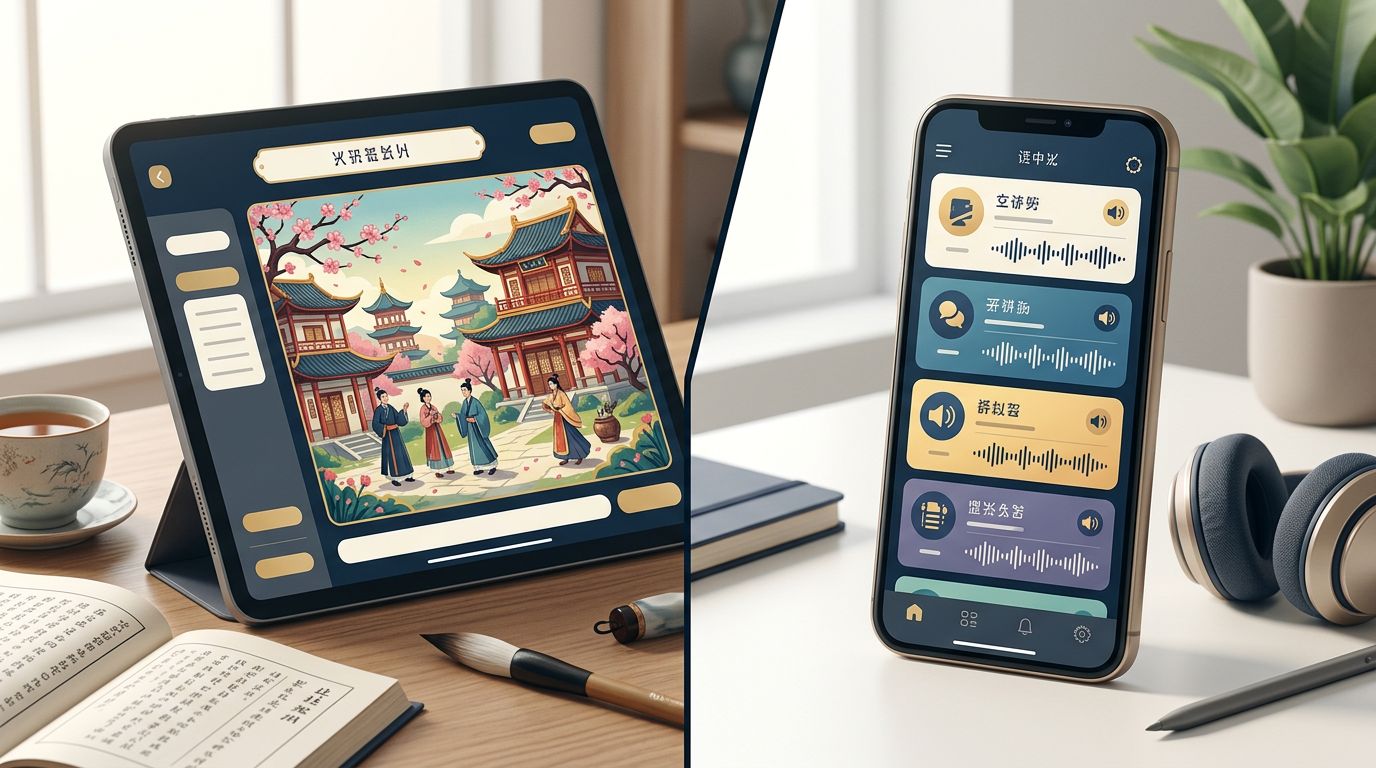
Reading apps can help you move past isolated vocabulary, but they don’t all train the same skill. Anyone comparing Du Chinese Immersive Chinese is usually choosing between full graded stories and tightly controlled sentence lessons.
Du Chinese offers broader passage-based reading, while Immersive Chinese provides a cheaper routine built around short sentences, audio, and repetition. Both suit beginner and intermediate learners, but the better choice depends on whether you want more content or more structure.
Du Chinese Immive Chinese: the reading models behind the apps
Reading practice has two jobs. First, it must help you understand the current text. Second, it should gradually prepare you for less-supported Chinese.
Du Chinese focuses on the first job through graded stories, articles, conversations, cultural pieces, and news. Its official reading app page describes a large library matched to different learner levels. You choose a text, listen to native audio, check unfamiliar words, and reread until the passage feels manageable.
Immersive Chinese follows a more controlled sequence. Its lessons use short sentences and repeated exposure to build recognition without giving you a large library of unrelated texts. That format can feel easier when you want a clear daily assignment.
The distinction is important. Du Chinese feels closer to a digital graded reader. Immersive Chinese feels closer to a structured sentence course with strong reading and listening support.
For a closer look at each product, see our Du Chinese review and Immersive Chinese review.
Du Chinese Immersive Chinese feature comparison
The Du Chinese Immersive Chinese comparison becomes clearer when you look at the basic reading unit in each app.

| Feature | Du Chinese | Immersive Chinese |
|---|---|---|
| Main reading unit | Stories, articles, conversations, and courses | Structured lessons and short sentences |
| Reported content | More than 3,000 articles, stories, and courses | 185 lessons and 4,500+ unique sentences |
| Difficulty | HSK 1 through HSK 6 | A controlled progression, strongest for beginner to intermediate study |
| Audio | Native audio synchronized with text, including sentence-by-sentence playback | Audio repetition built into lesson practice |
| Reading support | Pinyin toggle, pop-up dictionary, translations, grammar notes | Adjustable pinyin support and vocabulary notes |
| Review tools | SRS flashcards, bookmarks, progress tracking | Repetition within the lesson sequence |
| Access | iOS, Android, and web access are reported | iOS and Google Play |
Du Chinese gives you more freedom to select material at your level. Immersive Chinese gives you fewer choices, which can reduce decision fatigue during a short study session.
Neither app replaces conversation practice, writing correction, or a complete Mandarin course. Their main value is helping you read and understand Chinese more often.
Why Du Chinese suits passage-based reading
Du Chinese is the stronger option when your goal is to read complete passages rather than practice one sentence at a time.
The app organizes content across HSK 1 to HSK 6, so beginners can start with simple dialogues while advanced learners can work through more demanding articles. The library includes everyday situations, cultural stories, history, and news. That range gives you more chances to meet vocabulary in context.
A current app listing reports more than 3,000 articles, stories, and courses. It also lists Simplified and Traditional Chinese support, synchronized audio, line-by-line translations, pinyin, grammar explanations, and dictionary integration.

The reading workflow is practical. You can first read with pinyin and translations available, then hide pinyin and reread the same passage. Tapping a word brings up a definition, while sentence audio helps you connect written forms with natural pronunciation.
Du Chinese also includes SRS flashcards, bookmarks, progress tracking, and offline study on eligible plans. Those features matter if you want to build a long-term reading routine instead of finishing a fixed course.
The trade-off is choice. A large library can make it harder to decide what to study next. Du Chinese also asks more from your budget than Immersive Chinese, especially if you use the app for several months.
Why Immersive Chinese suits controlled practice
Immersive Chinese works well for learners who prefer a fixed sequence and repeated exposure. Rather than choosing among thousands of texts, you follow lessons that introduce and recycle useful sentence patterns.
As of 2026, the app listing reports 185 lessons and more than 4,500 unique sentences. It also offers 36 free lessons, with the remaining content available through subscription or lifetime access. That free section is large enough to test the teaching style before paying.
The app’s design favors short, focused sessions. You can listen to a sentence, read it, review vocabulary, and repeat the process without switching between several parts of the interface. Adjustable pinyin support lets you reduce pronunciation help as your character recognition improves.
This structure is useful when a large reading library feels intimidating. It also suits learners who need more controlled input before moving into longer stories.
Immersive Chinese has a narrower content model than Du Chinese. Its public information emphasizes lessons and sentences, rather than a large collection of articles across many genres. You may therefore finish the available sequence and need another tool for sustained intermediate or advanced reading.
It also isn’t a broad speaking course. The audio supports listening and pronunciation awareness, but the app doesn’t provide live conversation or detailed speech feedback.
Pricing and platform differences in 2026
Price is one of the clearest differences, although Du Chinese figures vary across plans and published sources.
| App | Reported 2026 pricing | Platform notes |
|---|---|---|
| Du Chinese | About $15 monthly, $79.99 yearly, and $119.99 lifetime figures appear in 2026 sources | Check the current in-app or web checkout because prices may vary |
| Immersive Chinese | Web console: $1.99 monthly, $4.99 for three months, $6.99 for six months, or $14.99 lifetime | App Store listings show different figures, including $3.99, $5.99, $8.99, and $17.99 lifetime |
The latest Du Chinese App Store listing is useful for checking platform availability and current purchase options. Still, Apple pricing can differ from web or Android pricing.
Immersive Chinese is much cheaper at the reported web prices. Its lifetime option is especially attractive if you want a structured course and don’t need a large stream of new reading material. However, confirm the price in your country before subscribing, since regional taxes, app-store fees, and currency conversion can change the final amount.
Du Chinese may justify the higher cost for daily readers who want continuing content, broader difficulty levels, and offline access. The value depends on how often you use that library.
Which app should you choose?
For the Du Chinese Immersive Chinese decision, start with the kind of reading you can maintain consistently.
Choose Du Chinese if you:
- Want stories, articles, conversations, and cultural content.
- Need material organized across HSK 1 to HSK 6.
- Prefer choosing texts based on topic and difficulty.
- Want synchronized audio, translations, dictionary lookups, and SRS review in one reading app.
- Plan to keep reading beyond a fixed lesson sequence.
Choose Immersive Chinese if you:
- Prefer a clear lesson order with little searching.
- Learn best through repeated sentence exposure.
- Want a low-cost or lifetime purchase option.
- Need adjustable pinyin while building character recognition.
- Are a beginner or intermediate learner who wants controlled practice before tackling longer passages.
You can also use both without duplicating their roles. Immersive Chinese can provide a short daily foundation, while Du Chinese can give you longer reading sessions several times each week. That combination only makes sense if the extra subscription cost fits your budget and you can maintain both routines.
The best test is simple: complete several free or sample lessons, then measure how often you return. An app with fewer features that you open five days a week will help more than a larger library you rarely read.
Conclusion
Du Chinese and Immersive Chinese solve different reading problems. Du Chinese is the better fit for learners who want a broad, level-based library of complete texts. Immersive Chinese is better for learners who prefer short lessons, repeated sentences, and a much lower price.
For anyone comparing Du Chinese Immersive Chinese, the strongest choice depends on your next reading goal. Choose Du Chinese when you need more content and progression. Choose Immersive Chinese when you need a focused routine that makes daily practice easy.
Ready to Take Your Language Learning Further?
Your favorite language-learning app is a great place to start. Rocket Languages can help you go further with interactive audio lessons, pronunciation practice, real-world conversations, and structured learning.
Explore Rocket Languages →Affiliate disclosure: We may earn a commission if you purchase through this link, at no additional cost to you.