
Icelandic is a unique North Germanic language that breaks thin apps fast. Complex cases, long compound words, and unusual endings expose weak lessons within days. If you want real progress in 2026, you need Icelandic learning apps that teach grammar, train your ear, and push you to speak.
Most students find that they do better with a stack of tools rather than relying on a single program. When you want to learn Icelandic language effectively, it helps to use one tool for structure, another to keep vocabulary moving, and a third to force real output. The best mix depends on your level, your budget, and how much time you can dedicate each week.
Key Takeaways
- Combine tools for best results: No single app covers everything; serious learners should build a stack that includes a core structural course, a vocabulary builder, and a platform for live speaking practice.
- Prioritize grammar-heavy courses: Due to Icelandic’s complex cases and verb patterns, you need a program like Icelandic Online that offers a clear A1–B2 pedagogical path rather than just vocabulary flashcards.
- Transition from input to output: Beginners should focus on building a grammatical foundation, while intermediate and advanced learners must shift their focus to speaking platforms like Preply or language exchange apps to overcome plateaus.
- Quality audio is non-negotiable: To train your ear for the unique cadence of Icelandic, ensure your chosen apps feature high-quality audio from native speakers rather than synthesized, robotic voices.
What serious Icelandic learners need from an app
A serious language learning app has to do more than flash words back at you. Icelandic grammar is complex, as nouns change form, verbs shift with person and tense, and endings carry real meaning. If an app hides these mechanics, it leaves you stuck when you try to read or speak.
Curriculum depth matters first. A clear path from A1 to B2 beats a polished home screen because you can see what comes next. A robust curriculum ensures your vocabulary grows alongside your understanding of complex sentence structures. For a sense of what a guided path feels like in a stronger mainstream course, the Busuu review for serious learners is a useful benchmark.
Grammar support should cover case endings, verb patterns, and word order. Listening needs input from native speakers, not clipped robot audio. High quality audio recordings are essential for your ears to adjust to the natural cadence of the language. Pronunciation help is better when the app lets you repeat phrases, hear them at both slow and normal speeds, or record your own voice to refine your speaking skills.
Offline access matters too. Commuters and travelers need lessons that still work on a plane or train. Pricing should match the depth, because a cheap app that stalls after 200 words wastes more time than it saves.
The best Icelandic app is the one that makes endings impossible to ignore.
The best Icelandic learning apps in 2026
If you want to learn Icelandic language skills effectively, you have several distinct options to choose from. The table below keeps the tradeoffs clear at a glance.
| App | Curriculum depth | Grammar support | Speaking/listening | Pronunciation help | Offline access | Pricing | Best for |
|---|---|---|---|---|---|---|---|
| Icelandic Online | High, A1-B2 path | Strong | Good listening, little live speaking | Basic audio models | Limited | Mostly free | Serious beginners |
| Memrise | Medium | Light | Good listening | Strong repetition | Partial | Freemium | Daily vocab review |
| Drops | Low to medium | Very light | Basic listening | Audio prompts | Limited | Freemium | Fast vocab bursts |
| LingQ | Medium | Light | Strong reading/listening | Shadowing only | Good with downloads | Freemium, paid tiers | Intermediate readers |
| Preply | No fixed course | Custom | Excellent live practice | Live correction | None | Pay per lesson | Speaking with a tutor |
| HelloTalk / Speaky | No fixed course | Very light | Good chat exchange | Voice notes | None | Free, paid extras | Conversation practice |
Icelandic Online is the only clear core course here. The others help with gaps. That is why most serious learners end up combining apps instead of trusting one product to do everything.
Icelandic Online
This is the closest thing to a full course for Icelandic. If you are looking to learn Icelandic online, this platform provides the lessons, exercises, and a structured path that helps you master grammar before focusing on speed. As a beginner, you will find the A1-B2 range particularly advantageous because it provides significant room to grow.
The tradeoff is that it feels more like a classroom tool than a playful app. Speaking practice is limited, and the interface is practical rather than flashy. Still, it is the safest starting point for those who want clear structure.
Memrise
Memrise is strong when you need daily recall and do not want to waste time. Its Icelandic material relies heavily on spaced repetition, helping you retain information over time. By using digital flash cards paired with native pronunciation clips, the app helps your ear and keeps your review sessions short and effective.
It does not replace dedicated grammar study, and the course depth stops well before fluency. Even so, it is one of the better choices for keeping Icelandic words active between deeper study sessions.
Drops
Drops is built for short bursts. Its Icelandic page focuses on practical vocabulary through interactive games, and the app covers more than 1,700 words across 99 topics. That makes it useful for building travel vocabulary or for learners who want low-friction, daily review.
You can see the app’s focus on its Drops Icelandic course page. It is handy for quick sessions, but it does not teach sentence structure or case endings. Treat it as a supplement, not a base.
LingQ
LingQ works best once you can handle some ambiguity. It lets you read and listen to real content, save new words, and build meaning from context. That makes it stronger for intermediate and advanced learners than for day-one beginners.
Grammar support stays light, so you still need a course beside it. However, if you want to move from textbook Icelandic into real text and audio, LingQ is one of the better places to do that.
Preply, HelloTalk, and Speaky
Once you need real output, these tools matter more than another vocab app. A tutor platform like Preply’s Icelandic tutor guide gives you the opportunity for real-world conversations and personalized corrections. That is hard to beat if speaking feels slow or awkward.
HelloTalk and Speaky are cheaper because they rely on exchange, but results depend on finding serious partners. None of these apps give you a full curriculum, so they work best after you already have a foundational structure.
How to build a study stack that actually works
The smartest setup is a small stack, not a huge folder of apps. To see real results, focus on habit building through consistent daily lessons. One app should teach grammar, one should keep your vocabulary moving, and one should force active use.
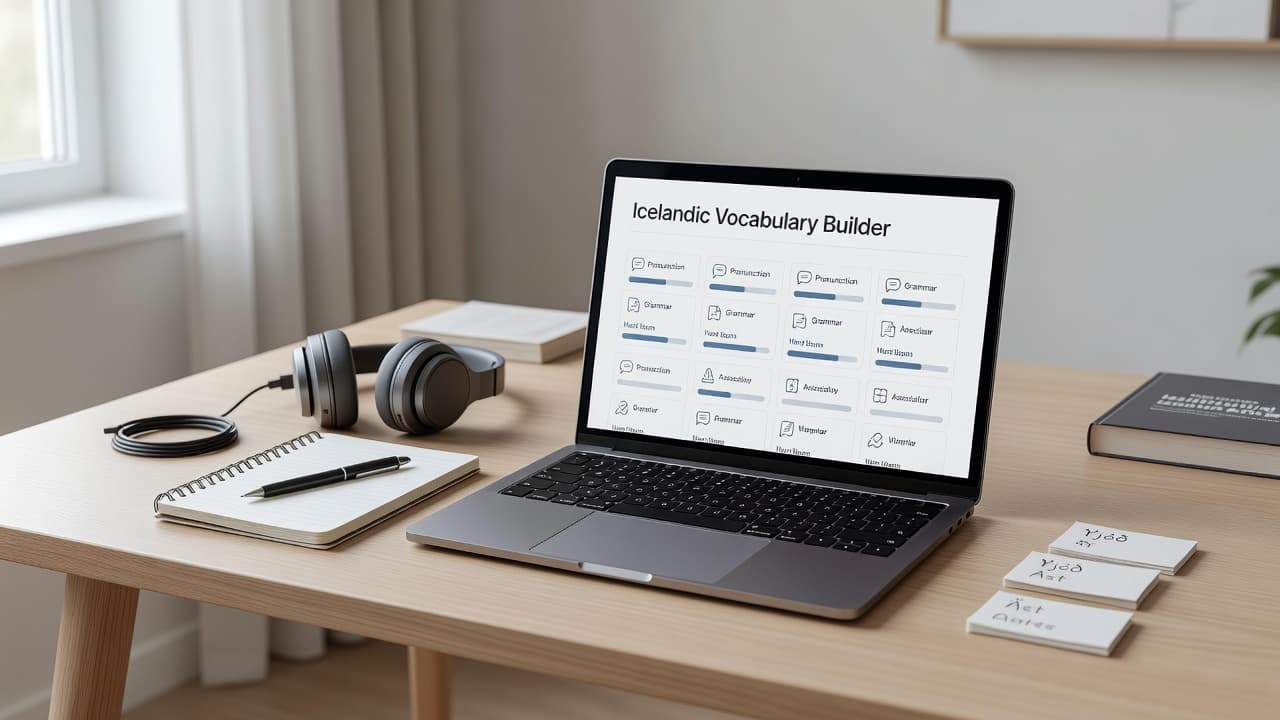
Start with Icelandic Online as your core. Add Memrise or Drops for daily review to build your practical vocabulary. Use LingQ once you can read short material without panic. Then book live speaking sessions with Preply or use HelloTalk and Speaky for lighter practice.
A sentence-drill system can also help once your base is stable. A method like the one discussed in the Glossika sentence drilling method shows why repetition matters after you know the basics. For those who prefer audio-first learning, this approach is often compared to the Pimsleur Method, as both prioritize auditory input and repetitive reinforcement.
A good stack for serious learners should target diverse language skills, ensuring you cover grammar, vocabulary, and listening through dedicated audio training. A typical setup looks like this:
- Beginners: Icelandic Online, plus Memrise or Drops for easy review and practical vocabulary.
- Intermediate learners: Icelandic Online, LingQ, and Preply.
- Advanced learners: LingQ, Preply, HelloTalk or Speaky, and custom flashcards in Anki to assist with long-term memorization.
That mix covers structure, recall, and live use. It also keeps you from confusing passive screen time with real study.
Which app fits your level and goal
If you are a beginner, start with Icelandic Online. It provides the structured grammar path that other apps often leave out, which is essential when you are first learning Icelandic phrases. You should consider adding Memrise or Drops to your routine only after the basics stop feeling strange and you have a solid grasp of your first few hundred words.
If you are at an intermediate level, LingQ becomes significantly more useful. At this stage, your focus shifts toward conversational fluency, as reading longer texts and hearing natural speech matter more than simply cramming extra nouns. You should continue to learn Icelandic language structures through immersive content, while using platforms like Preply to test what you know in real, live conversations.
Advanced learners need output pressure to break through plateaus. HelloTalk, Speaky, and consistent tutor sessions matter far more than another gamified lesson. Since Duolingo does not currently offer Icelandic, the usual easy shortcut is off the table. That makes building a careful, intentional app stack even more important for reaching true proficiency.
Frequently Asked Questions
Can I learn Icelandic using only one app?
While some learners try to rely on a single program, most find it ineffective for Icelandic. Because the language has complex grammar and unique sentence structures, you will likely need a structured course for grammar combined with supplemental tools for vocabulary and live practice.
Is there an official Duolingo course for Icelandic?
No, Duolingo does not currently offer a course for Icelandic. This makes it even more important for learners to be intentional about building their own study stack using the professional resources available.
Which app is best for a complete beginner?
Icelandic Online is widely considered the best starting point for beginners. It offers the most comprehensive, structured curriculum that explains essential grammar rules, which are often glossed over by more casual, game-based apps.
How do I practice speaking if I do not live in Iceland?
Tutor platforms like Preply are the most effective way to gain real speaking experience through live, personalized corrections. Alternatively, language exchange apps like HelloTalk or Speaky can provide conversational practice, though they lack the structured feedback of a professional tutor.
Conclusion
Icelandic is a challenging language to master with shallow tools, so the most effective approach in 2026 remains a small, focused study stack. Use Icelandic Online for structure, Memrise or Drops for quick recall, and Preply or exchange apps when you need to practice speaking.
The strongest Icelandic learning apps are those that serve distinct purposes. By carefully selecting a specific language learning app for each task, you ensure that grammar, vocabulary, and speaking all live in the same routine. When these three pillars are integrated into your daily habits, your progress stops feeling random and starts becoming a permanent part of your knowledge.
Ready to Take Your Language Learning Further?
Your favorite language-learning app is a great place to start. Rocket Languages can help you go further with interactive audio lessons, pronunciation practice, real-world conversations, and structured learning.
Explore Rocket Languages →Affiliate disclosure: We may earn a commission if you purchase through this link, at no additional cost to you.