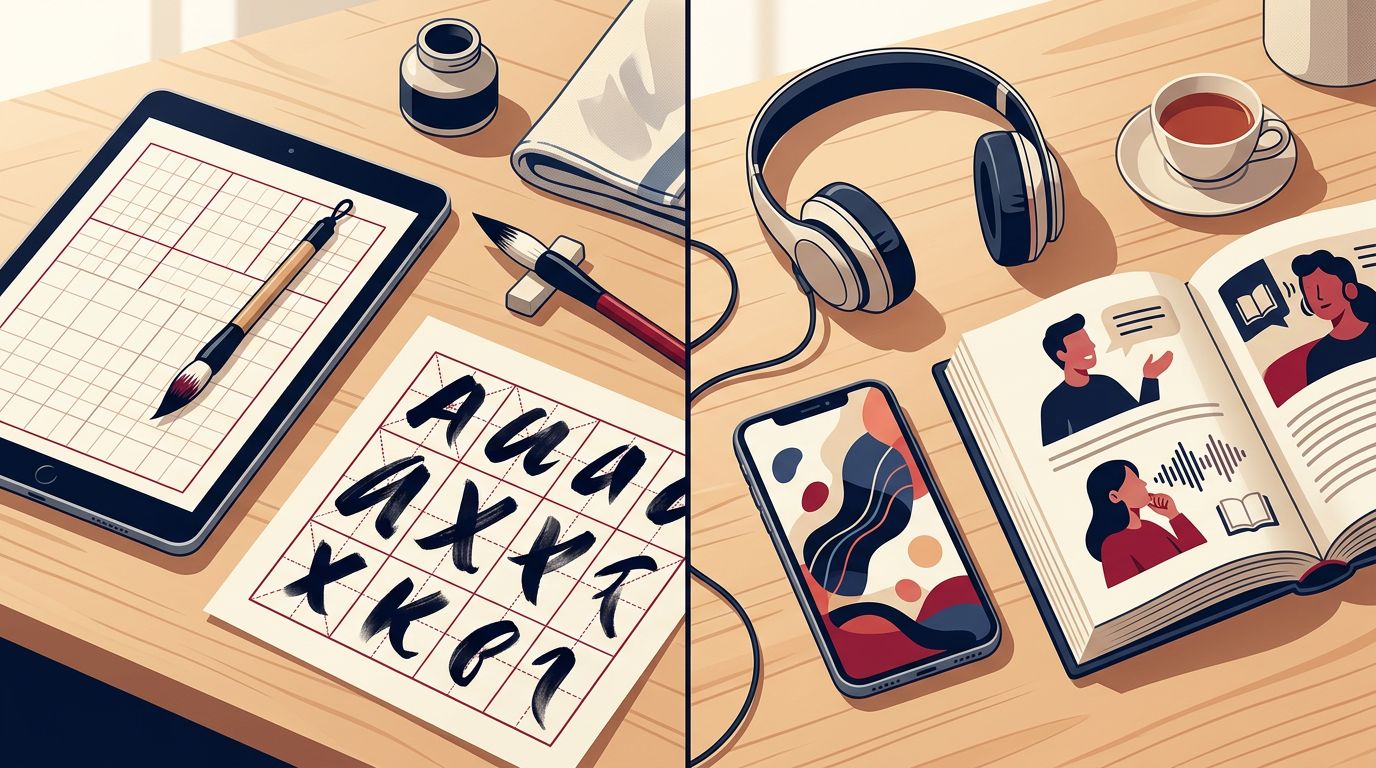
Writing Chinese characters from memory is a different skill from recognizing them on a screen. Many learners can identify 汉字 in a sentence, yet forget the next stroke when asked to write one.
That difference matters when comparing Skritter vs Dong Chinese in 2026. Skritter is built around handwriting production, while Dong Chinese gives characters more context through reading, listening, subtitles, and explanations. A broader Chinese app comparison from DigMandarin also highlights Skritter’s focus on stroke order and muscle memory.
Key Takeaways
- Skritter is the stronger choice for repeated, stroke-by-stroke character production.
- Dong Chinese supports handwriting, but its main focus is understandable Mandarin input.
- Skritter offers clearer current pricing, while Dong Chinese pricing varies by store and region.
- Learners preparing for handwritten exams or building writing fluency should favor Skritter.
- Using Dong Chinese for context and Skritter for production can work well if you have time for both.
The main difference between Skritter and Dong Chinese
Skritter treats writing as the center of the lesson. You see a prompt, recall the character, and draw it with your finger, mouse, or stylus. The app checks your strokes as you work, including stroke order and the shape of the character. Spaced repetition then brings the item back before you are likely to forget it.
That process forces active recall. Instead of thinking, “I know that character when I see it,” you must retrieve its structure and produce it. For learners who need accurate handwriting, that distinction is the main reason to consider handwriting practice with Skritter.
Dong Chinese takes a wider approach. Its lessons connect characters with sentences, videos, subtitles, frequency information, character components, and pronunciation. Handwriting practice is available, but it sits inside a broader Mandarin study system rather than controlling the whole experience. The app’s central purpose is helping learners understand more spoken and written Chinese.
This difference affects how each app feels during a study session. Skritter gives you more direct writing repetition, while Dong Chinese gives you more reasons to encounter a character in meaningful language. One app behaves more like a handwriting trainer. The other works more like a structured input and comprehension tool that includes character study.
A useful way to frame the choice is to ask what happens when you meet an unfamiliar character. Skritter asks you to reproduce it. Dong Chinese helps you understand where it appears, what it means, and how it sounds in context. Both outcomes support retention, but they train different responses.
An older overview of Chinese character apps makes a similar distinction between tools that explain characters and tools that require learners to write them. That distinction remains useful in 2026, even as app features continue to change.
How the writing practice compares
Character writing involves more than remembering a rough outline. You need to recall the character’s components, place them correctly, follow common stroke order, and keep the proportions readable. Skritter gives these elements more direct attention than Dong Chinese.
| Writing need | Skritter | Dong Chinese |
|---|---|---|
| Produce characters from memory | Core activity | Available, but not the main activity |
| Stroke-by-stroke feedback | Central feature | Less central in the study experience |
| Spaced repetition | Built into writing review | Used within broader learning and review |
| Character components | Includes character insights | Includes component and etymology explanations |
| Contextual reading and listening | Supporting material | Major focus |
| Textbook or exam organization | Textbook lists, HSK and TOCFL tags | Organized around Mandarin content and comprehension |
Skritter’s stroke-level feedback is valuable when your errors are physical. You may know that 好 contains 女 and 子, yet still place a stroke incorrectly or distort the shape. Immediate correction prevents the wrong movement from becoming familiar.
The app also includes character insights from Outlier Linguistics. These explanations break characters into parts and discuss their structure, which can make unfamiliar forms easier to remember. However, the explanation supports the writing task rather than replacing it. You still have to produce the character.
Dong Chinese can help with a different kind of problem. Perhaps you recognize 学 but don’t understand how it appears in real sentences. Context, subtitles, and connected vocabulary can give the character a stronger place in memory. Its component and etymology information may also answer why a character looks the way it does.
That support can improve recall, but recognition and production remain separate skills. If you mostly tap answers, read subtitles, or identify characters, your handwriting may lag behind your comprehension. Dong Chinese’s handwriting option helps close that gap, although learners seeking intensive motor practice may find Skritter more focused.
If writing accuracy is your main target, choose the app that makes you produce characters repeatedly, not the one that merely shows them more often.
Skritter also lets learners work with simplified and traditional Chinese, along with vocabulary connected to common textbooks. Its HSK and TOCFL tags can help you organize study around an exam or proficiency goal. Dong Chinese is less about completing a writing syllabus and more about building understanding through Mandarin content.
Pricing, platforms, and daily study
As of July 2026, Skritter lists several paid plans in US dollars. The monthly plan is $14.99. Longer subscriptions reduce the monthly equivalent:
| Skritter plan | Listed price | Approximate monthly cost |
|---|---|---|
| Monthly | $14.99 | $14.99 |
| Six months | $59.99 | $9.99 |
| Twelve months | $99.99 | $8.33 |
| Twenty-four months | $179.99 | $7.50 |
Skritter also offers a seven-day trial and limited free access to seven beginner decks on mobile. Free access has restrictions, including account and statistics limits. The service works on the web, iOS, and Android, so you can write on a phone, tablet, or computer.
Dong Chinese is available on iOS and Android as of July 2026. Current purchase options and prices vary by app store and region, and reliable fixed plan figures aren’t available across markets. Check the official product and pricing pages before paying because subscriptions, trial access, and included features can change.
For daily study, Skritter works well as a focused ten to fifteen-minute writing session. You can review a small deck, concentrate on troublesome characters, and stop after completing deliberate production practice. The app’s improved deck organization and customizable input options help you shape that routine.
Dong Chinese fits longer comprehension sessions. You might read a graded story, review subtitles, listen to a dialogue, and inspect unfamiliar characters. Its value grows when you want to connect writing with words you have heard or read repeatedly.
A combined routine can be effective. Use Dong Chinese to meet characters in sentences and audio, then use Skritter to practice the items that you need to write. Avoid transferring every new character into a separate deck. Select words that match your current lessons, work, exam, or personal communication needs.
For learners comparing several Mandarin tools, the Pleco vs Dong Chinese comparison offers useful context. Dong Chinese is closer to a guided learning environment, while Pleco is mainly a dictionary and lookup tool. Neither comparison changes the central point here: writing practice needs dedicated production time.
Which app fits your learning goal?
Skritter is the better fit when you need to write Chinese by hand with confidence. That includes learners preparing for handwritten tests, students taking classroom notes, heritage learners rebuilding literacy, and beginners who want to establish correct stroke habits early.
It also suits people who enjoy measurable repetition. The prompt-response format makes your weak characters visible. If you repeatedly confuse 未 and 末, or forget the lower component of 想, Skritter brings those problems back until recall improves.
Dong Chinese is a better fit when reading and listening are your first priorities. It can help you understand characters through sentences and native media rather than isolated flashcards. Learners who find writing drills tedious may practice more consistently when handwriting appears alongside content they already want to understand.
The choice also depends on your definition of progress. If success means writing a character without a model, Skritter has the clearer match. If success means following a Mandarin video, reading a short story, or recognizing vocabulary in conversation, Dong Chinese covers more of that path.
Neither app replaces the other for every learner. A person who wants fluent comprehension but also needs reliable handwriting may benefit from both. Someone with only fifteen minutes per day should pick the tool that trains the skill they cannot afford to neglect.
A practical decision for 2026
Choose Skritter first if your priority is active character production. Its stroke feedback, spaced repetition, writing prompts, textbook lists, and exam tags give handwriting a clear place in your routine.
Choose Dong Chinese first if you want characters tied to understandable reading and listening. Its explanations and media-based study can make Mandarin input more useful, especially when isolated writing drills don’t hold your attention.
Before subscribing, check current plans, supported devices, and regional availability on each service’s official pages. App pricing and feature lists can change during the year, so older reviews shouldn’t be your only source for purchase details.
If you’re still unsure, test the study action rather than the feature list. Write ten characters in Skritter, then complete a Dong Chinese lesson and see which activity exposes the gap you want to fix. The better choice is the one that makes your target skill impossible to ignore.
Conclusion
Skritter and Dong Chinese support character learning through different forms of practice. Skritter places handwriting recall, stroke order, and correction at the center, while Dong Chinese builds character knowledge through broader Mandarin comprehension.
For accurate active production, Skritter is the more direct choice. For context-rich reading and listening with optional handwriting support, Dong Chinese may fit better. When recognition comes easily but writing still breaks down, the right app is the one that makes you put the character on the page.
Ready to Take Your Language Learning Further?
Your favorite language-learning app is a great place to start. Rocket Languages can help you go further with interactive audio lessons, pronunciation practice, real-world conversations, and structured learning.
Explore Rocket Languages →Affiliate disclosure: We may earn a commission if you purchase through this link, at no additional cost to you.